Archaeologists Discover the Ancient Dinosaur Remains Dated as the Oldest Ever Detected Beneath Denver
Discovered Beneath the Denver Museum of Nature and Science: A 67.5-million-year-old Dinosaur Vertebra
A remarkable discovery has been made in the heart of Denver, Colorado. A 67.5-million-year-old dinosaur vertebra, the deepest and oldest dinosaur fossil ever found within Denver city limits, was unearthed 763 feet beneath the Denver Museum of Nature and Science's parking lot [1][3].
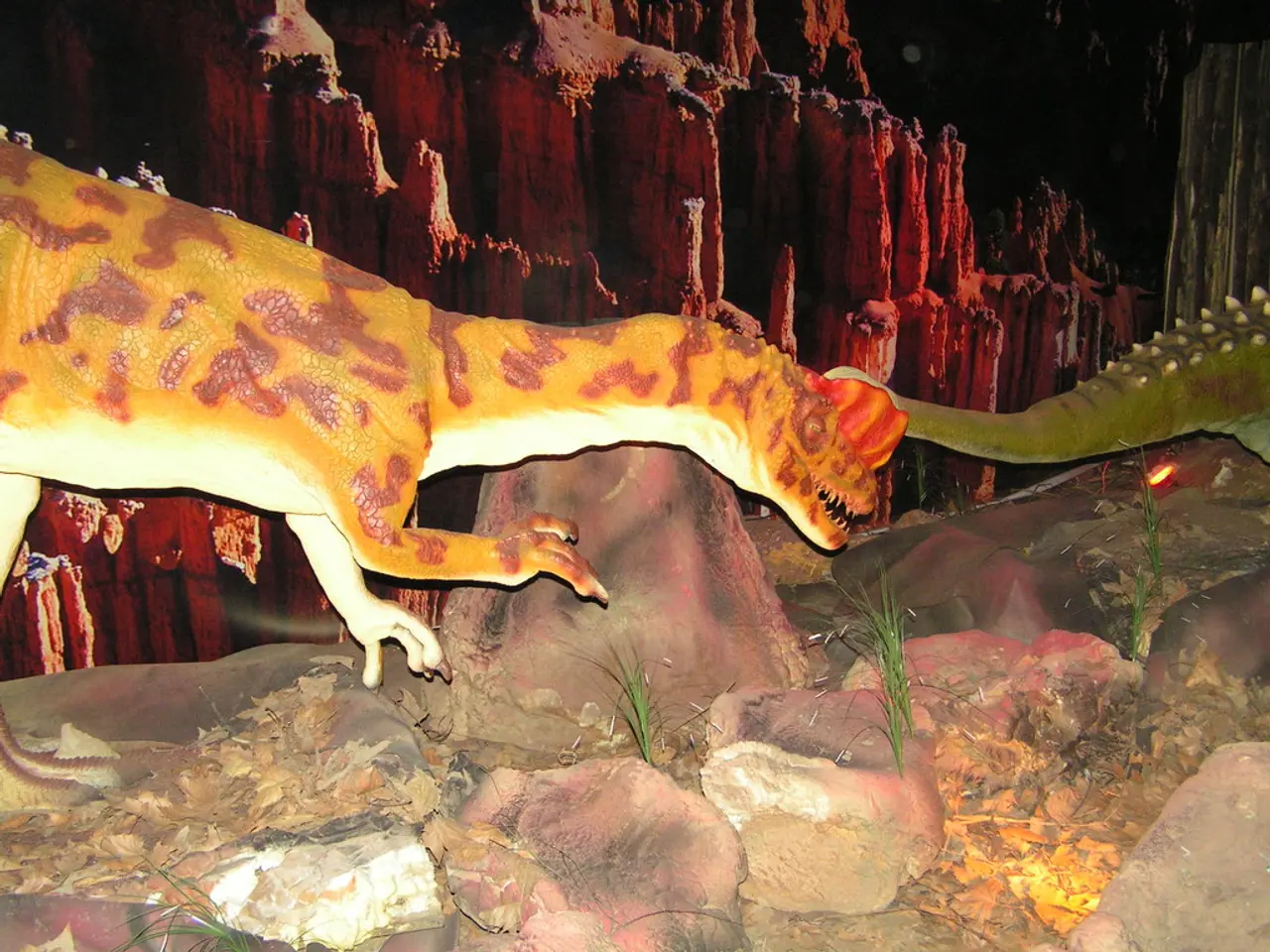
This historic find offers a unique glimpse into the region's prehistoric ecosystem, just 1.5 million years before the mass extinction that ended the age of dinosaurs. The vertebra, belonging to a herbivorous dinosaur, was discovered during a geothermal energy drilling project, marking one of the very few times a dinosaur fossil has been found from such a deep core sample [1].
The discovery has significant implications:
- Rare Geological Context: The fossil's location in a deep core sample is extraordinarily rare worldwide, with only two other similar finds documented [1]. The discovery inside a museum parking lot dedicated to natural history adds an additional layer of archaeological significance.
- Paleoenvironments and Ecosystem Inference: Alongside the bone, fossilized vegetation indicated that the Denver Basin was once a swampy, lush, and humid environment during the late Cretaceous. This contextualizes the dinosaur's habitat and enriches our understanding of the region's prehistoric climate and ecology [1].
- Multidisciplinary Research Potential: The find emerged from a project initially aimed at studying the viability of geothermal energy to replace natural gas at the museum site. The scientific coring conducted alongside these efforts allowed researchers to study deep geological layers with new precision, emphasizing the value of integrating energy and environmental research with paleontology [1][2].
- Public Engagement: The fossil is now exhibited in the museum’s “Discovering Teen Rex” exhibition, highlighting its role in public education and science communication. It also demonstrates the unexpected rewards that can come from sustainability initiatives, linking climate solutions exploration with groundbreaking scientific discovery [2].
This discovery provides a rare, exceptionally deep glimpse into the late Cretaceous ecosystem of the Denver Basin, deepens geological and paleontological research, and represents an extraordinary intersection of green energy exploration and ancient life studies [1][2].
According to Bob Raynolds, an Earth scientist, the find is "nothing short of magical" [1]. A researcher, Hagadorn, imagines the dinosaur using the pond where the bone was found for drinking water or feeding on plants nearby [1]. The bone was discovered during a routine drilling operation to assess geothermal energy for the museum's heating and cooling systems [1].
This discovery is more than just a fossil; it is a piece of the puzzle that helps researchers piece together the history of life on Earth and how it evolved over time. The bone, now a symbol of scientific discovery and environmental sustainability, continues to captivate the imagination and fuel curiosity about the world's ancient past.
[1] The Denver Post. (2021, June 24). 67-million-year-old dinosaur bone found beneath Denver Museum of Nature & Science parking lot. Retrieved from https://www.denverpost.com/2021/06/24/dinosaur-bone-denver-museum/
[2] Denver Museum of Nature & Science. (2021, June 24). Newly discovered dinosaur bone offers unique insights into prehistoric ecosystem. Retrieved from https://www.dmns.org/news/newly-discovered-dinosaur-bone-offers-unique-insights-into-prehistoric-ecosystem/
[3] Denverite. (2021, June 24). A 67.5-million-year-old dinosaur bone was found beneath the Denver Museum of Nature and Science's parking lot. Retrieved from https://denverite.com/news/a-67-5-million-year-old-dinosaur-bone-was-found-beneath-the-denver-museum-of-nature-and-science-parking-lot/
The discovery of the 67.5-million-year-old dinosaur vertebra beneath the Denver Museum of Nature and Science's parking lot offers a unique opportunity for researchers in medical-conditions and environmental-science fields. Being one of the few times a dinosaur fossil has been found from such a deep core sample, this discovery has significant implications for understanding the conditions of the late Cretaceous prehistoric ecosystem. Furthermore, advancements in technology, such as geothermal energy drilling, enable scientists to explore even deeper layers of the Earth, leading to unexpected discoveries like this one in space-and-astronomy and paleontology.